philosophy
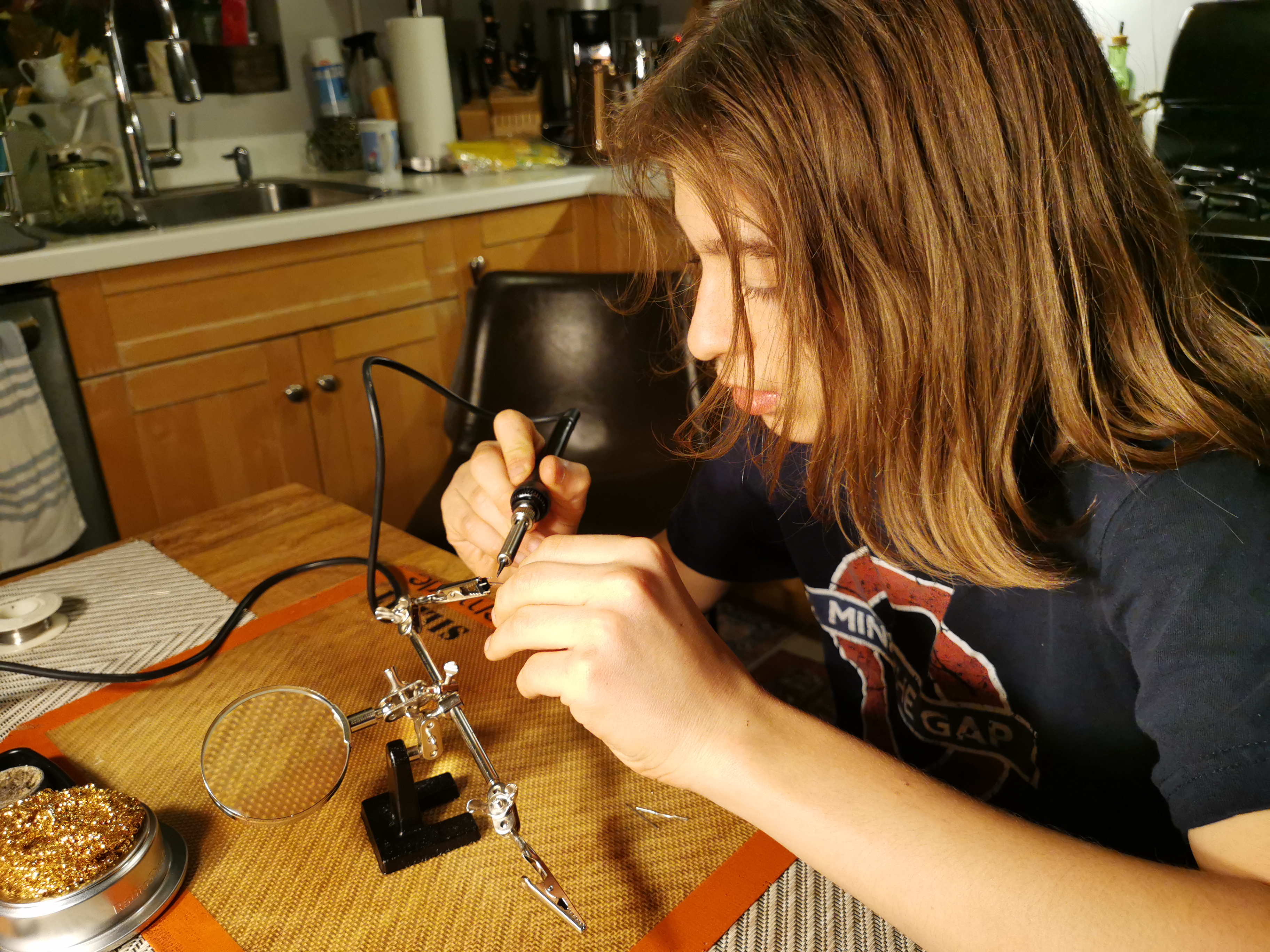
In the New Year I resolved to pursue a long-brewing plan to launch an after school and summer program to teach young people a wide array of science, technology and engineering concepts, in a uniquely immersive and cross-disciplinary way. My own son is now close to thirteen years old, and we have spent his childhood working on amazing science and engineering projects since he was old enough to make use of opposable fingers. We have brought his friends and classmates into these experiences, and it has proven a joy to share these activities.
We have also experienced many of the currently running after school science and technology programs. Most are extremely well-intentioned, and we appreciate that they have provided invaluable coverage on many busy work days. However, I have seen patterns that leave much room for improvement. These gaps are worth describing, because they shape where I would like programming to go:
There is an under-appreciation for the challenge levels young people are capable of. I have consistently heard my son's classmates and friends describe their experiences as under-challenging, under-engaging, under-aspirational, and repetitive. I see one important factor being age, which should not be allowed to reduce the level of challenge to anyone, and which is an imminently solvable challenge.
There is a reluctance to tackle projects that pose even the slightest degree of risk, which sharply curtails the quality of nearly any scientific, engineering or technological study. This is not an appeal to return to an age of 'what doesn't kill them...' but to the benefit of teaching proper safety practices, to not inadvertently be teaching fearfulness, or to disadvantage them in an extremely competitive global marketplace. A carefully calculated degree of risk is also what makes life -- or a science project -- interesting.
There appears to be little programming that focuses on practical applications. The teaching of concepts through the repeated construction of solar-powered soda can cars and similarly rudimentary projects simply does not serve as a solid launch pad to deeper, independent exploration. The projects my son and I take on are always iterative projects, where we are able to revise, improve and advance our designs to ever more challenging and sophisticated levels. Iteration is a key element in science and engineering, and an important part of maintaining engagement.
Currently available programs do not take a multi-disciplinary approach. Engineering projects involve research, parts and materials sourcing, experimentation, testing, documentation, information sharing, design in software, physical prototyping and building, ramping up to mass manufacturing, and even marketing. Existing programs (and off-the-shelf science kits) hand everything to students, stealing from them the opportunity to explore or to be fully invested in their projects. By engaging young learners in all stages and disciplines that need to come together to advance a scientific or engineering endeavor, students can find their preferred roles, leading to much surer first steps into higher-level education and careers. What better way to provide an early taste than to have kids learn about and try out the many available roles?
These points not only express my perspective on the shortcomings of many currently available youth science and tech programs, but hopefully they also paint a rough picture of my educational programming goals.
Putting together such a program is a massive undertaking. Covering logistics, staffing, admissions, parent communication, advertising, materials preparation, and so forth, is monumental. I believe this is actually the reason for why so many existing programs fall short on the education front: they are simply too busy keeping the programs running to be able to properly focus on the education part. This isn't a criticism, but a challenge that should be overcome, for the sake of what's really important.
So, why do I write and post this? I need the great minds of this community -- people who see the value in launching such a program -- to tell me that they, too, would like to work toward launching and working at such a place and on such a program as has been described.
Why do I want to do this? First off, I really like kids. I love how they fearlessly throw things at the wall to see what might stick. I worry about their futures, given the litany of trends acting against them from so many different directions. I strongly believe that immersive, challenging and group-oriented activities are the strongest counters to many of the trends on that list. I believe that they are headed into technology-dominated futures, and should be armed to stay ahead of this juggernaut.
How am I qualified to take this on? I have been blessed with a childlike curiosity, since I was... well... a child. I spent that childhood tearing things apart and putting things back together, and just never stopped doing this. I have either formally studied or taught myself much in many of the areas that will be relevant to our activities, including electronics, programming, graphic and industrial design, all forms of tool-work, woodwork, metalwork, 3D-printing, rocketry, astronomy... the list is long.
Finally, I have run businesses, managed teams, worked on public projects, and I enjoy building purposeful organizations every bit as much as I enjoy building science kits. I believe a well-designed educational program can prove affordable for families, life-changing for students, profoundly rewarding for educators, profitable for investors (of either time, money, or both), and directly beneficial to our society at multiple levels.
After many years of contemplating this, I hold a very clear picture of what a program would look like, down to many of the details. I would like to share and bring other, well-intentioned and well-qualified minds into the planning process, and I prefer collaboration over working alone (hence this post). If you have had similar thoughts about directing your skills and experience toward young learners, and have resources (technical knowledge, ideas, time, skill, or capital) that you would want to see directed to establishing such a program, at first locally, and eventually more widely, please contact me at sstromer@steampunksnyc.com.