manufacturer review:
gotrax scooters
By Steven Stromer, Jun 24, 2024
It is finally time to write my first article on electric scooters. This has been a long time coming. I discovered scooting during the pandemic, when the NYC subway came to resemble scenes from The Walking Dead, and I needed a way to get around above ground.
Given the post-pandemic explosion of e-vehicles, I imagine many people discovered these forms of alternate transport for similar reasons. Eight GoTrax scooter purchases, thousands of road miles, and countless repairs and upgrades later, I feel I finally have enough experience with the brand to cover these vehicles in a useful way.
Most scooter-related content reviews particular models. With reviews so well handled elsewhere, this series instead focuses on manufacturer build quality, support for self-service repair, and technical maintenance and repair procedures.
decks
GoTrax scooters have so much going for them. The introductory and commuter level models all sport large, flat, low-slung decks that extend around the sides of the rear wheel, ideal for occasionally carrying a large package or a passenger. Combined with lower than average handlebar height, the result are vehicles with low centers of gravity and an extremely easy to control ride. Of course, the low deck assures occasionally bottoming out on curbs, but it's a small price to pay for the sensation of stability, especially for less experienced or less confident riders.
longevity and ruggedness
Despite the occasional posts from owners who have had atypical experiences with prematurely failing motors, controllers or batteries, I can say that I have literally tortured these low-cost machines, while enjoying at least three years of hard, daily use from each. With this level of longevity, these units represent an absolutely exceptional value.
motors
Their motors punch well above their rated wattages, offering significant torque off the line and on steep inclines, outperforming more highly rated competitor vehicles in this regard. It is unfortunate that the majority of the lower-end GoTrax models cap top speed to 15.5 mph, especially when this is clearly an imposed limitation, and not a ceiling resulting from mechanical or structural limitations.
tires, tubes and wheels
While I cannot comment on GoTrax models with larger wheel dimensions, I can speak extensively on the performance of their 8-1/2" diameter motors, wheels and tires. Something about the machine milling of these wheels causes tire tubes to fail way too frequently. I admit that I am an agressive rider, which doesn't help. However, I have found that the area around the valve stems on both front and rear tubes abraids and fails quickly, regardless of the tube brand. My theory is that if GoTrax would enlarge the hole for the valve stem, and line it with a hardened rubber or plastic insert, tubes would last significantly longer.
Compound this high failure rate with the absurd complexity of replacing a punctured tube, and it soon became obvious to me that the routine wasn't sustainable. To replace a tube on either front or rear wheel, multiple plastic covers must first be removed. Then, even with proper tire levers and heavy-duty zip-ties (a recommended methiod that I will soon cover), the task of removing and installing the tire on the wheel is an absurdly challenging and awkward process that can easily lead to a new tube being inadvertently punctured in the process. Finally, with the extremely tiny portion of the stem that protrudes from the wheel, necessitating a the use of a short, specialized extension hose to fill the tube, the air-filling process becomes a game of over-inflating the tube, and then racing to disconnect the filler tube before the small tube empties.
Frustrated by the painfully cumbersome process of replacing tubes at least two dozen times, I finally opted for tubeless tires on practically all of the scooters I maintain, despite the rougher ride. Now, some competitors offer wheels and motor hubs with removable rims, making tube and tire replacement a significantly easier process. While it's a seemingly insignificant feature, I have practically come to view openable rims as a make-or-break feature.
batteries
GoTrax batteries appear to primarily be produced by TaoTao, a reputable manufacturer. Their battery packs consistently exceed ratings, lasting much longer on each charge than their costs, sizes and technical specs would imply, and handling many more charge cycles than can reasonably be expected.
However, here, too, I have discovered two specific issues that buyers should be aware of. First off, I have noticed a very reliable pattern where the highly specific battery packs used by GoTrax have a tendency to disappear from the market, just as the manufacturer-installed packs finally reach their end of life.
Try, for instance, to locate a JT-BC200-15 or a TT-DD853-5.2, replacement battery models for the hugely popular GoTrax GXL V2. Or, try to get ahold of a TT-DD858-7.8 the replacement battery for the GoTrax XR Elite. If you do manage to locate any of these packs, expect them to cost as much as a new scooter, a pricing model that makes so little sense that it doesn't feel accidental. In fact, if you do manage to find a source for any of these packs that is reasonably priced, make sure to let me know! I find this lack of availibility extremely concerning, for a multitude of reasons, which I'll soon delve into further.
The second issue regards the specific ways in which I have experienced battery packs dying. On only one case have I managed to wear a GoTrax battery down to the point where it simply could not power the scooter to its expected capability. Every single other pack died in a sudden moment of failure while driving, usually on a larger than average bump.
I have documented the failures inside of the packs, and will cover these failures in an forthcoming article. Once again, I believe that small manufacturing changes could have prevented these failures. First, GoTrax does not provide any form of padding or shock absorbtion at the contact points for their batteries. I believe that this alone would make a huge difference. Further, I can think of a multitude of ways in which to provide both better heat dissipation and thermal overload protection to keep packs from catastrophic failure. Unfortunately, the current outcome of battery failure, when combined with costly and hard-to-find replacement batteries, essentially dooms affected scooters to the trash bin.
customer service
While GoTrax's lower-end models lack some of the frills of similarly priced competitors, like phone-based control apps, highly informative control panel screens, and sleek, rounded finishes, they make up for these superfluous features with solid construction and absolutely impressive performance-to-weight ratios.
However, there are two key negatives that have colored my appreciation for the brand. First, and foremost, is customer service. GoTrax, in the United States, does not do customer service well. Once, in desperation, I reached out to GoTrax's Canadian support line, where I unexpectedly received absolutely exceptional support, despite my being located in a different country.
In that particular instance, I was unable to source a simple replacement part from GoTrax's U.S.-based support services, despite asking on occasion for a period extending over many months. They simply could not tell me when the replacement part might become available, and were unwilling to assist further, leaving me stranded, with no other source to turn to. Their Canadian counterparts happily drop-shipped the part I needed to my door, direct from China. The part was at my door in under a week. This difference is proof that U.S. customer service fails by management and culture, not by incapacity.
right-to-repair
Technically, GoTrax sells repair parts directly to customers. The company offers a repair service, as well. However, when something goes wrong, whether a broken part, or an error reporting on the display screen, GoTrax insists that the entire scooter be shipped to them for evaluation, at the customer's expense. It does not matter how technically capable the customer may be, nor whether the scooter is still in warranty. GoTrax appears to be seeking to make as much profit, and to limit as much liability, as possible, when something goes wrong with a scooter.
Unless you are the type of customer who immediately throws away devices the moment they need maintenance or repair, you will eventually need customer service support for your scooter. After all, they are asked to take a lot of abuse, and all vehicles require upkeep.
Additionally, every model of GoTrax scooter I've used has suffered from one or two seemingly small design flaws that were limited in scope to very specific parts. These flaws cause the same parts to fail in the same way, over and over. GoTrax never acknowledge these issues -- even when many customers are bringing their shared experiences to the attention of the company. Instead, GoTrax appears to address these design flaws in later model revisions, leaving early adopters behind, or pressed to buy revised models and abandon otherwise perfectly fixable vehicles.
Should I be surprised, in our disposable, planned-obsolescence, refuse-to-repair economy? Yes, I think I should be. A major element of the e-vehicle culture is environmental sustainability and reduced footprint. Throwing away a scooter, along with a five pound Lithium-ion battery, just because a part hssn't been made available, is environmentally unconscionable. A second major cultural underpinning is affordability. Many scooter riders simply can't afford to drive more expensive vehicles. The availability of a ten-dollar part should not dictate a $400, or costlier, total vehicle replacement.
Throwing away a scooter, along with a five pound Lithium-ion battery, just because a part hasn't been made available, is environmentally unconscionable.
A third cultural point of e-vehicle use is maintainability and upgradeability. Much like bicyclists and motorcyclists, scooter operators tend to be inclined to perform their own maintenance and upgrades. The inevitability of the battery's expiration should offer more than sufficient guaranteed obsolescence. For any smart manufacturer, it's a no-brainer that a customer is going to return when a scooter lasts three problem-free years, needing replacement only after the battery has finally stopped taking a charge.
The buyers of units plagued with well-documented issues are then forced to either purchase the flawed parts, over and again, to keep their scooters functioning. GoTrax does nothing to improve the design of the flawed parts, does not offer replacements, does not issue recalls, and does nothing to own up to these situations.
A case in point. The GoTrax XR Elite (https://gotrax.com/products/xr-elite-commuting-electric-scooter) has performed exceptionally for me for two months shy of three years. In fact, it's such a workhorse that I own two of them. I have literally tortured this vehicle on the utterly abusive streets of the city. I have overloaded it, treating it more like a pickup truck than like the urban commuting scooter that it is. It has taken me through storms, and has doubled as an electric-powered hand-truck on countless occasions.
However, I have done all of that without a rear fender, and so, with every damp day, I have arrived at work with a rooster-tail of mud covering the back of my clothing. In the course of those three years, I replaced the fender five different times, each time requiring a full teardown of the scooter's rear end in order to rewire the brake light.
Simply and obviously, the fender's design lacks the structural support ribs designed into the fenders of nearly ever other GoTrax model, rendering it incapable of withstanding the bumps and cracks of urban streets. It would have taken GoTrax nearly no effort to have added a few plastic ribs to the plastic mold in order to rectify the problem. They could have similarly produced an add-on brace to owners of this model. Riding with the rear tire exposed, just behind the rider's foot is not an inconvenience; it's a safety matter.
On the replacement part page for this specific item, owners of this model have posted for years about this issue, often pleading with GoTrax to address it. To add to the issue, GoTrax has not bothered to keep this replacement part available in stock, or to offer replacement fenders when owners have experienced the problem.
Along with others, I documented and reported this issue in detail to GoTrax, with the company ignoring my letters requesting help, and then demanding help. They outlasted me. When the batteries finally died, I purchased another brand to replace both vehicles.
All of this does not yet get to my main reason for writing about GoTrax scooters. In my multiple repair experiences with the brand's various models, I have become knowledgeable about how they're built, and how to maintain them. While I won't be purchasing the brand in the future, I want to document and share the information I've collected about the maintenance and repair of GoTrax vehicles, since the company has done just about as little as possible to document their scooters' internals as possible. I have never been able to find technical documents detailing teardown, parts diagrams, diagnostic methods, or anything similar. Again, it feels like there's a preference for minimizing repairability, even if it's not the intention.
In my next article, we will begin to document the teardown and parts of GoTrax scooters, and to show where they fail, why they fail at these points, and how to address these points of failure when they occur.
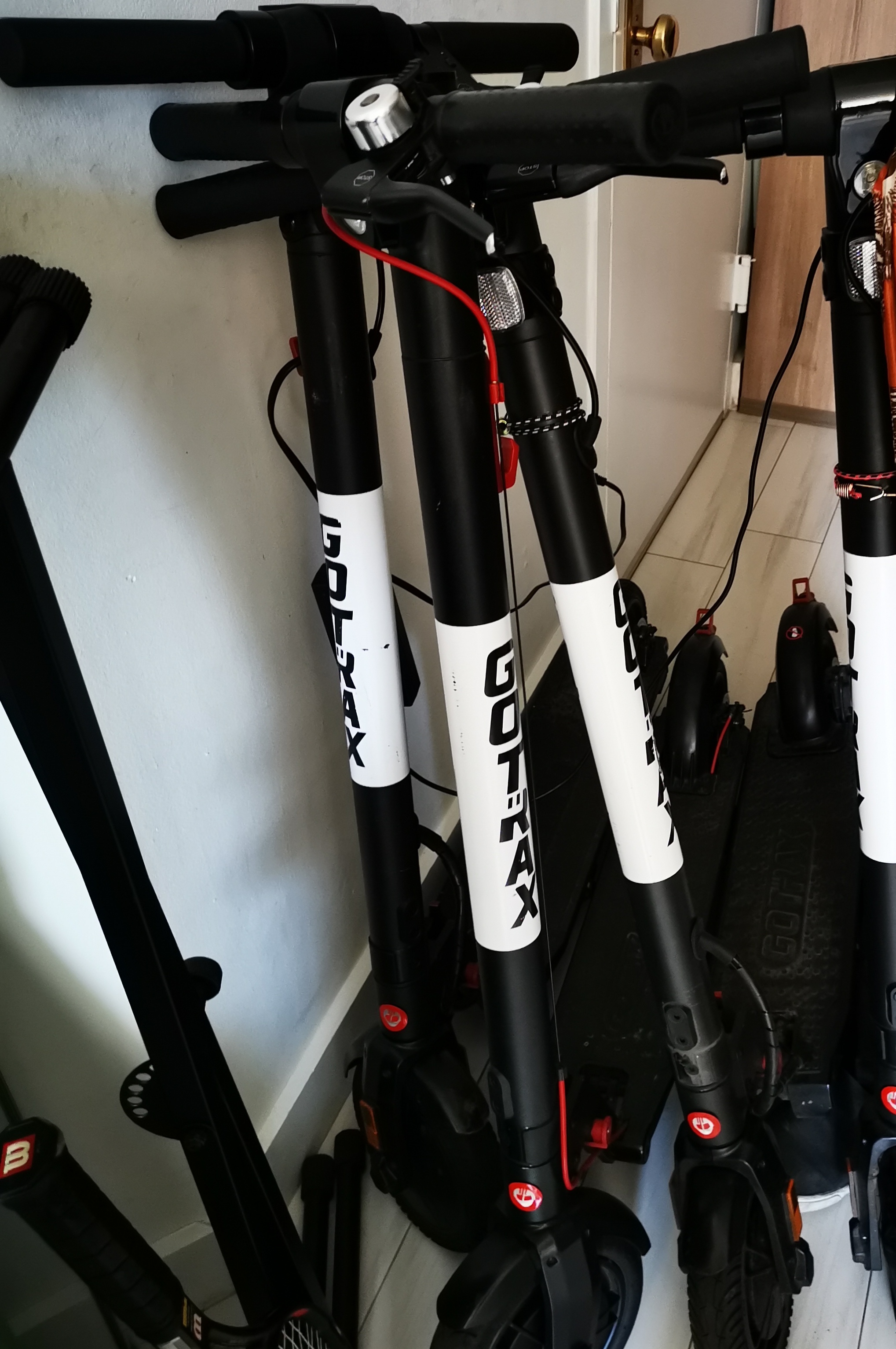

the rear of the deck conveniently wraps around the rear wheel, providing extra footing on a crowded deck, while the rear fender is unsupported, regularly breaking at the base on rough city streets
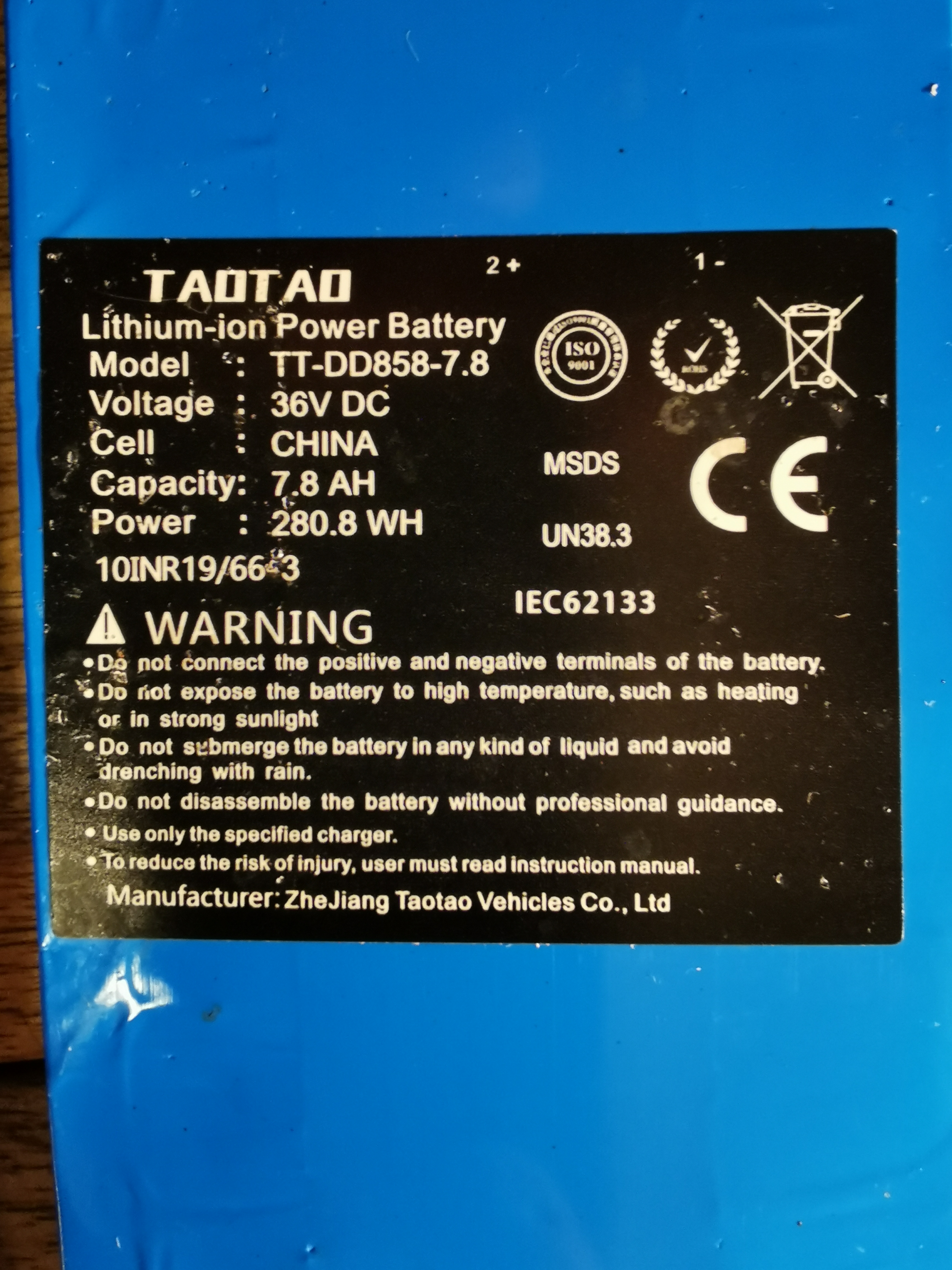
GoTrax XR Elite battery. images © steven stromer
most scooter-related content reviews particular models, so, with reviews so well handled elsewhere, this series instead focuses on manufacturer build quality, support for self-service repair, and technical maintenance and repair procedures